Description
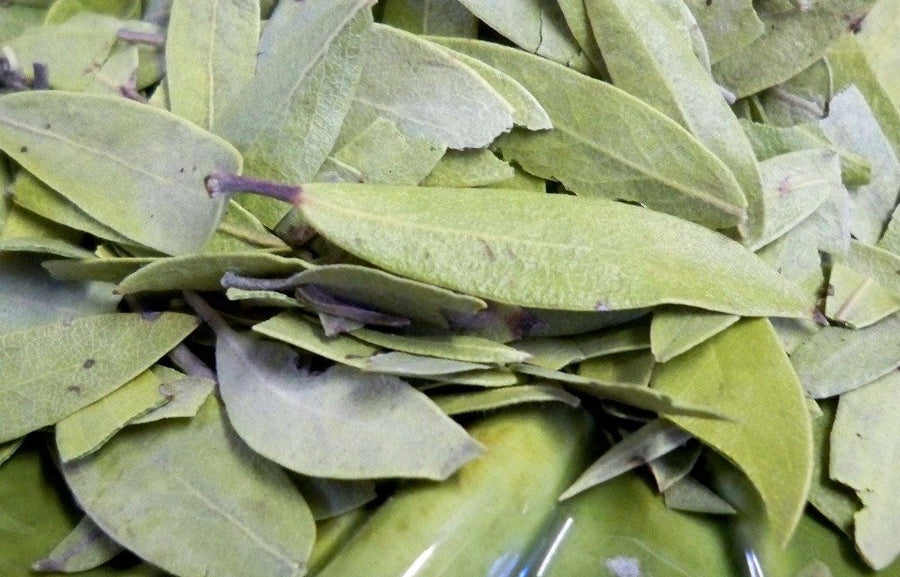
Uva Ursi Leaf, Cut & Sifted — Wildcrafted
(Arctostaphylos uva-ursi)
Arctostaphylos uva-ursi — Uva Ursi, Bearberry, Kinnikinnick, or Pinguica — is a low-growing, mat-forming evergreen shrub of the family Ericaceae with one of the most remarkable geographic distributions of any plant on Earth — it is one of the most truly circumpolar plants known, found continuously across the boreal and arctic regions of North America, Europe, and Asia, from Greenland and Iceland across Scandinavia, Russia, and Siberia to Japan, and south through the mountains of Europe, the Himalayas, and the Rocky Mountains of North America. Arctostaphylos uva-ursi grows in the thin, acidic, well-drained soils of open forests, rocky hillsides, sand dunes, and tundra, forming dense, spreading mats of small, leathery, dark green leaves and producing small, bright red berries in autumn. The botanical name is a remarkable linguistic redundancy — Arctostaphylos derives from the Greek arktos (bear) and staphyle (grape), while uva-ursi is the Latin for “grape of the bear” — both the genus and species names mean exactly the same thing in different languages, a double bear-grape. The common name “Bearberry” reflects the same observation — bears are known to eat the berries enthusiastically. The alternative common name Kinnikinnick comes from an Algonquian word meaning “smoking mixture” — the dried leaves of Arctostaphylos uva-ursi were one of the most important components of traditional smoking mixtures used by many Indigenous peoples of North America, either alone or blended with tobacco and other botanicals. The Spanish common name Pinguica reflects the plant’s use in Mexican and Central American traditional botanical practice. Uva Ursi leaf has been used in European botanical medicine since at least the 13th century — it was described by the Welsh physicians of Myddfai in the 13th century and was listed in the London Pharmacopoeia from 1788 through the 20th century. Wildcrafted.
Arctostaphylos uva-ursi leaf contains one of the most distinctive and well-characterized phytochemical profiles of any ericaceous plant, most notably arbutin (hydroquinone-beta-D-glucopyranoside — the primary phenolic glycoside and quality marker, typically comprising 5–15% of dry leaf weight — one of the highest concentrations of any plant source), methylarbutin, hydroquinone (the aglycone of arbutin), piceoside, tannins (gallotannins and ellagitannins — approximately 15–20% of dry leaf weight, among the highest tannin concentrations of any botanical leaf; including corilagin, ellagic acid, gallic acid, and 1,2,3,4,6-pentagalloylglucose), flavonoids (including quercetin, myricetin, hyperoside, isoquercitrin, quercitrin, avicularin, kaempferol, luteolin, and ericolin), iridoids (asperuloside and monotropein), triterpenes (ursolic acid, oleanolic acid, alpha-amyrin, beta-amyrin, and uvaol), phenolic acids (gallic acid, ellagic acid, caffeic acid, chlorogenic acid, p-coumaric acid, syringic acid), allantoin, resin, wax, calcium, potassium, magnesium, iron, manganese, and zinc. Wildcrafted. Available in Cut & Sifted form.
Product Highlights
- Cut & sifted leaf of Arctostaphylos uva-ursi — Uva Ursi / Bearberry / Kinnikinnick / Pinguica
- Wildcrafted — one of the most truly circumpolar plants on Earth, found continuously across the boreal and arctic regions of North America, Europe, and Asia
- The botanical name is a double bear-grape: Arctostaphylos (Greek: bear-grape) + uva-ursi (Latin: grape of the bear)
- Kinnikinnick — from the Algonquian for “smoking mixture” — the dried leaves were one of the most important components of traditional Indigenous North American smoking blends
- Listed in the London Pharmacopoeia from 1788 through the 20th century; used in European botanical medicine since the 13th century
- Primary bioactive compound: arbutin — typically 5–15% of dry leaf weight, one of the highest concentrations of any plant source
- Exceptionally rich in tannins — approximately 15–20% of dry leaf weight, including corilagin, ellagic acid, and pentagalloylglucose
- Wildcrafted. Available in Cut & Sifted form
How to Use
Herbal Tea (Cold Infusion — Preferred): Cold infusion is preferred over hot infusion to minimize tannin extraction and preserve arbutin — steep 1–2 teaspoons of cut & sifted uva ursi leaf in 8 oz of cold water for 8–12 hours; strain and drink. Hot Infusion: Steep 1–2 teaspoons in 8 oz of hot (not boiling) water for 10–15 minutes; strain. The flavor is strongly astringent and bitter due to the high tannin content. Tincture: Effective alcohol extraction of both arbutin and tannins. Herbal Blends: Traditionally combined with other botanical herbs in herbal tea formulas.
Wildcrafted. Available in Cut & Sifted (2 oz, 4 oz, 8 oz).
These statements have not been evaluated by the Food and Drug Administration. This product is not intended to diagnose, treat, cure, or prevent any disease. Consult your healthcare provider before use if you are pregnant, nursing, taking medications, or have a medical condition. Not recommended for long-term use or use in children. Keep out of reach of children.
Related products