Description
Tulsi Ginger Orange Tea
(Ocimum tenuiflorum — Holy Basil)
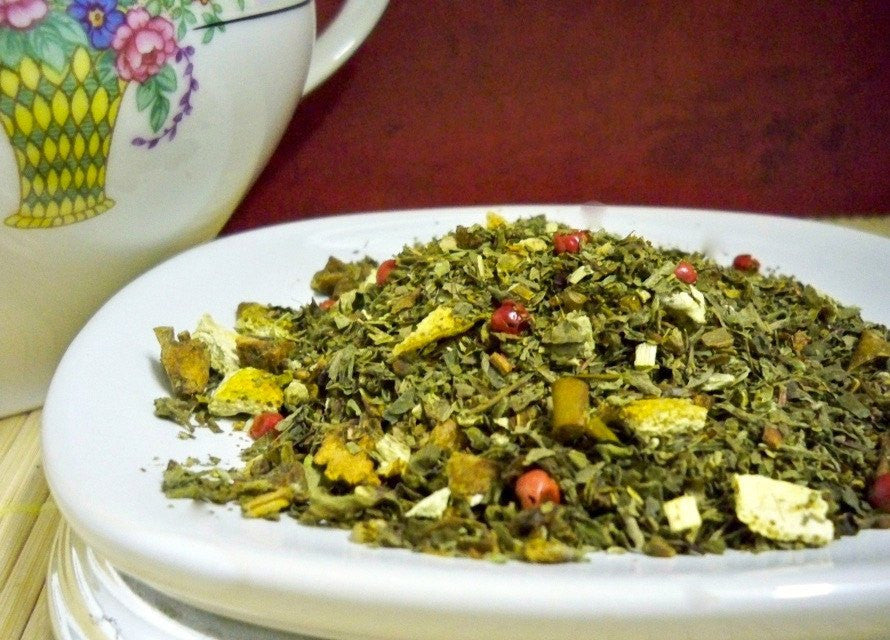
Tulsi — Ocimum tenuiflorum, known throughout India as Holy Basil — is one of the most revered and widely used botanicals in the 5,000-year history of Ayurvedic tradition. Considered sacred in Hindu culture and cultivated in virtually every traditional Indian household, tulsi has been at the center of Indian botanical practice longer than almost any other herb. This is a hand-blended Ayurvedic-inspired tea that brings tulsi together with ginger, cinnamon, anise, star anise, pink peppercorns, orange, apple, green rooibos, and safflower petals — a warming, aromatic, spice-forward blend with a bright citrus lift and a complex, layered character unlike anything else in our collection. We blend ours with a little more spice than most — because we believe spice is where the magic lives. 4 oz makes approximately 50 cups.
Ingredients: Tulsi Herb (Ocimum tenuiflorum — Holy Basil), Ginger (Zingiber officinale), Green Rooibos (Aspalathus linearis), Cinnamon (Cinnamomum verum / Cinnamomum cassia), Anise (Pimpinella anisum), Orange Pieces, Apple Bits, Star Anise (Illicium verum), Pink Peppercorns (Schinus molle), Orange Slices, Safflower Petals (Carthamus tinctorius), Natural Flavor. Naturally caffeine-free.
Key Botanicals
- Tulsi / Holy Basil (Ocimum tenuiflorum) — a small, aromatic annual or short-lived perennial of the family Lamiaceae native to the Indian subcontinent and widely cultivated throughout Southeast Asia and the tropics. One of the most important plants in Hindu religious and botanical tradition — considered sacred to Vishnu and cultivated in temple courtyards and household gardens throughout India for millennia. Tulsi has been documented in Ayurvedic texts including the Charaka Samhita and Sushruta Samhita — foundational texts of Ayurvedic medicine dating to approximately 600 BCE — and has been in continuous use in Indian botanical tradition for over 3,000 years. The phytochemical profile of Ocimum tenuiflorum includes eugenol (the primary phenylpropanoid — also the dominant compound in clove), rosmarinic acid, ursolic acid, oleanolic acid, beta-caryophyllene, linalool, methyl eugenol, carvacrol, beta-elemene, germacrene D, apigenin, luteolin, orientin, vicenin, isovitexin, quercetin, kaempferol, cirsilineol, cirsimaritin, isothymusin, isothymonin, salvigenin, caffeic acid, chlorogenic acid, vitamin C, vitamin A (beta-carotene), calcium, iron, potassium, magnesium, and zinc. Three primary chemotypes of tulsi are recognized — Rama tulsi (green leaf, mild), Krishna tulsi (purple leaf, more peppery and clove-like), and Vana tulsi (wild tulsi, most aromatic) — each with a distinct phytochemical profile and aroma.
- Ginger (Zingiber officinale) — the rhizome of the ginger plant, native to Maritime Southeast Asia and one of the most widely consumed spices in the world; contains gingerols (primarily 6-gingerol, 8-gingerol, and 10-gingerol — the pungent compounds responsible for fresh ginger’s characteristic heat), shogaols (formed from gingerols during drying — more pungent than gingerols), paradols, zingerone, zingiberene, beta-bisabolene, alpha-farnesene, beta-sesquiphellandrene, borneol, camphene, linalool, citral, cineole, terpineol, quercetin, kaempferol, caffeic acid, chlorogenic acid, ferulic acid, vitamin C, vitamin B6, magnesium, potassium, manganese, and copper. Ginger has been used as a culinary spice and botanical in South Asian, East Asian, and Middle Eastern traditions for over 5,000 years.
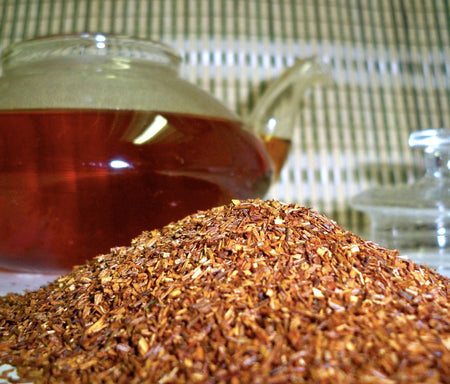
- Green Rooibos (Aspalathus linearis) — unoxidized (unfermented) rooibos from the Cederberg region of South Africa; lighter, grassier, and more delicate in flavor than red rooibos, with a higher concentration of aspalathin (the signature dihydrochalcone flavonoid of rooibos, found almost exclusively in Aspalathus linearis) and nothofagin, along with quercetin, luteolin, orientin, isoorientin, vitexin, isovitexin, and rutin. Naturally caffeine-free and very low in tannins.
- Cinnamon (Cinnamomum verum / Cinnamomum cassia) — the dried inner bark of the cinnamon tree; contains cinnamaldehyde (the primary volatile compound — responsible for cinnamon’s characteristic warm, sweet, spicy aroma), eugenol, linalool, beta-caryophyllene, coumarin (higher in cassia than in Ceylon cinnamon), cinnamyl acetate, procyanidins (type A and B), quercetin, kaempferol, caffeic acid, ferulic acid, calcium, iron, manganese, and vitamin K
- Star Anise (Illicium verum) — the star-shaped fruit of a small evergreen tree native to southwestern China and northeastern Vietnam; the dominant volatile compound is trans-anethole (typically 80–90% of the essential oil) — the same compound responsible for the flavor of anise seed, fennel, and pastis/absinthe — along with foeniculin, estragole, alpha-pinene, limonene, linalool, quercetin, kaempferol, rutin, caffeic acid, shikimic acid (the compound used as the starting material for the synthesis of oseltamivir/Tamiflu), calcium, iron, magnesium, and vitamin C
- Pink Peppercorns (Schinus molle) — the dried berries of the Peruvian pepper tree, native to the Andes of South America; not a true pepper (Piper nigrum) but a member of the family Anacardiaceae (related to cashew and mango); contains alpha-phellandrene, beta-phellandrene, limonene, delta-3-carene, alpha-pinene, beta-pinene, myrcene, terpinolene, linalool, terpinen-4-ol, quercetin, kaempferol, gallic acid, and tannins; contributes a mild, fruity, slightly resinous warmth that is distinctly different from black pepper
- Anise (Pimpinella anisum) — the seed of the anise plant, native to the eastern Mediterranean and Southwest Asia; like star anise, dominated by trans-anethole (typically 80–90% of the essential oil), along with pseudoisoeugenol, anise ketone, estragole, beta-caryophyllene, linalool, alpha-pinene, limonene, quercetin, luteolin, apigenin, caffeic acid, chlorogenic acid, calcium, iron, magnesium, and potassium
- Safflower Petals (Carthamus tinctorius) — the vivid orange-red petals of the safflower, one of humanity’s oldest cultivated plants (cultivated in Egypt for over 4,000 years); used primarily as a visual botanical in tea blends, contributing brilliant orange-red color; contains carthamin (the red pigment), safflower yellow (a chalcone glycoside), quercetin, kaempferol, luteolin, hydroxysafflor yellow A, anhydrosafflor yellow B, and serotonin derivatives
How to Brew
Steep 1–2 teaspoons per 8 oz of water at 200–208°F for 5–7 minutes. The flavor is warming, aromatic, and complex — spiced and earthy from the tulsi and ginger, sweet and citrusy from the orange and apple, with a distinctive anise note from the star anise and anise seed and a gentle fruity warmth from the pink peppercorns. A touch of honey is a beautiful pairing. Iced: Brew double-strength, steep 7 minutes, strain, sweeten lightly while hot, and pour over ice — exceptional cold. 4 oz makes approximately 50 cups.
Caffeine-free. Keep out of reach of children. Store in a cool, dry place away from direct sunlight. Star anise and anise seed contain trans-anethole — not recommended in large quantities during pregnancy. Not for use during pregnancy without consulting a qualified healthcare provider.
These statements have not been evaluated by the Food and Drug Administration. This product is not intended to diagnose, treat, cure, or prevent any disease.