
Description
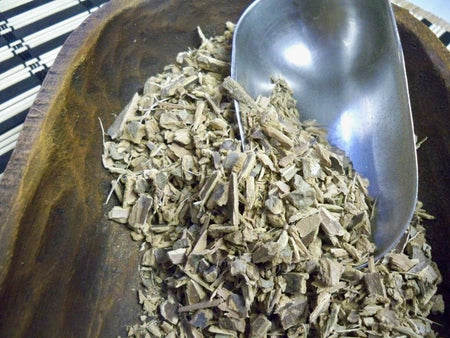
Rhubarb Root, Turkey
(Rheum officinale)
Rheum officinale — Chinese Rhubarb, Medicinal Rhubarb, or Turkish Rhubarb — is one of the most historically significant and commercially important medicinal plants in the history of East-West trade. A large, robust perennial of the family Polygonaceae native to the mountainous regions of western China and Tibet, Rheum officinale produces enormous basal leaves and a thick, fleshy root that has been one of the most prized commodities in the global spice and medicine trade for over 2,000 years. The designation “Turkey Rhubarb” does not refer to the country of origin but to the historic trade route — medicinal rhubarb root was transported from China through Central Asia and the Ottoman Empire (Turkey), where it was traded in the great bazaars of Constantinople and Smyrna before reaching European markets. This trade route made Turkish Rhubarb one of the most expensive and sought-after medicinal commodities in medieval and early modern Europe — at times more valuable by weight than opium or saffron. Rheum officinale is described in the Shennong Bencao Jing (Divine Farmer’s Classic of Materia Medica — circa 200 AD) and has been a cornerstone of traditional Chinese medicine (TCM) for millennia, where it is known as Da Huang (大黄 — “Great Yellow”), a reference to the vivid yellow color of the root’s interior.
The root contains a distinctive and well-characterized array of phytochemicals including anthraquinones (the primary active compounds — including emodin, rhein, aloe-emodin, chrysophanol, and physcion, both as free aglycones and as glycosides), anthrone glycosides (sennosides A and B — the primary laxative compounds), stilbene glycosides (rhaponticin, desoxyrhaponticin, rhapontigenin), tannins (including gallotannins and condensed tannins — including lindleyin and isolindleyin), oxalic acid, malic acid, citric acid, calcium oxalate, starch, pectin, phenolic acids (gallic acid, protocatechuic acid), and flavonoids (quercetin, kaempferol, catechin). Available in Cut & Sifted and Powder forms.
Product Highlights
- Cut & sifted and powdered root of Rheum officinale — Chinese Rhubarb / Turkish Rhubarb / Da Huang (大黄)
- One of the most historically significant medicinal trade commodities in the history of East-West commerce
- Known as Da Huang (大黄 — “Great Yellow”) in traditional Chinese medicine — a cornerstone of the TCM materia medica for over 2,000 years
- Described in the Shennong Bencao Jing (circa 200 AD) — one of the oldest and most important botanical texts in history
- The “Turkey” designation refers to the historic Ottoman trade route through which Chinese rhubarb reached European markets
- Rich in anthraquinones (emodin, rhein, aloe-emodin, chrysophanol), sennosides, stilbene glycosides, and tannins
- Available in Cut & Sifted and Powder forms
How to Use
Herbal Tea (Decoction): Simmer ½–1 teaspoon of cut & sifted rhubarb root in 8 oz of water for 10–15 minutes; strain. The flavor is bitter, astringent, and distinctly earthy with a characteristic yellow color. Use in small amounts. Tincture: Use in alcohol-based tincture preparations. Herbal Blends: Traditionally combined with other bitter and digestive botanicals in traditional Chinese and Western herbal formulas.
Available in Cut & Sifted (4 oz, 8 oz, 16 oz) and Powder (4 oz, 8 oz, 16 oz).
These statements have not been evaluated by the Food and Drug Administration. This product is not intended to diagnose, treat, cure, or prevent any disease. Consult your healthcare provider before use if you are pregnant, nursing, taking medications, or have a medical condition. Not recommended during pregnancy or nursing. Not recommended for long-term use. Rhubarb root contains anthraquinones and oxalic acid — use only in small amounts and for short periods. Keep out of reach of children.
Related products