Description
Wormwood Herb
(Artemisia absinthium)
Artemisia absinthium — Common Wormwood, Grand Wormwood, or Absinthe Wormwood — is a strongly aromatic, silver-grey perennial herb of the family Asteraceae native to temperate regions of Eurasia and northern Africa, naturalized throughout North America, where it grows in disturbed soils, roadsides, and dry, rocky hillsides. Artemisia absinthium is one of the most historically significant and botanically well-documented bitter herbs in the world — it has been in continuous use as a culinary, aromatic, and botanical herb for at least 3,500 years, referenced in ancient Egyptian papyri, the Ebers Papyrus (c. 1550 BCE), the writings of Hippocrates, Dioscorides, and Pliny the Elder, and throughout medieval European herbal tradition. The genus Artemisia is named for the Greek goddess Artemis, and the species name absinthium derives from the Greek apsinthion — meaning “undrinkable” or “without sweetness” — a reference to its intensely bitter taste. Wormwood is the defining botanical ingredient of absinthe — the legendary high-proof distilled spirit produced in Switzerland and France from the 18th century onward, famously associated with the Bohemian artistic culture of 19th-century Paris and consumed by Van Gogh, Toulouse-Lautrec, Verlaine, and Rimbaud. The characteristic bitterness of wormwood comes from absinthin and artabsin — sesquiterpene lactones that are among the most intensely bitter naturally occurring compounds known. Wormwood is also one of the classical “bitter herbs” (maror) of the Jewish Passover Seder tradition. Our Wormwood Herb is the dried aerial parts (leaf and flowering tops) of Artemisia absinthium, offered for use as a culinary bitter flavoring and aromatic botanical.
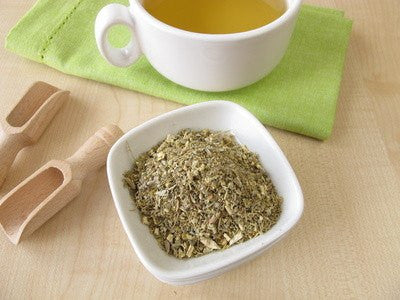
Artemisia absinthium herb contains a well-documented phytochemical profile including thujone (alpha-thujone and beta-thujone — the primary monoterpene ketones of the essential oil, typically 3–12% of the essential oil), absinthin (a highly bitter sesquiterpene lactone dimer), artabsin, anabsinthin, matricin, chamazulene (formed from matricin during distillation), azulene, camphor, sabinene, myrcene, trans-sabinyl acetate, linalool, borneol, terpinen-4-ol, beta-pinene, alpha-pinene, p-cymene, flavonoids (including artemetin, casticin, chrysoeriol, luteolin, quercetin, rutin, and isoquercitrin), phenolic acids (including chlorogenic acid, caffeic acid, ferulic acid, and p-coumaric acid), tannins, inulin, mucilage, resin, calcium, potassium, magnesium, iron, manganese, and zinc. Available in Cut & Sifted form.
⚠️ Safety Note: Wormwood contains thujone, a monoterpene ketone that is toxic in large or concentrated amounts. Wormwood herb should be used only in small amounts as a culinary bitter flavoring — it is not intended for prolonged or high-dose use. Do not use during pregnancy or nursing. Do not use if you have epilepsy or a seizure disorder. Do not use in combination with prescription medications without first consulting a qualified healthcare provider. Keep out of reach of children. This product is the dried herb intended for use as a culinary flavoring in traditional, moderate amounts — it is not an essential oil or concentrated extract.
Product Highlights
- Dried aerial parts of Artemisia absinthium — Common Wormwood / Grand Wormwood / Absinthe Wormwood
- One of the most historically significant bitter herbs in the world — referenced in the Ebers Papyrus (c. 1550 BCE) and used continuously for over 3,500 years by ancient Egyptians, Greeks, Romans, and throughout European herbal tradition
- The defining botanical ingredient of absinthe — the legendary distilled spirit associated with Van Gogh, Toulouse-Lautrec, Verlaine, and the Bohemian artistic culture of 19th-century Paris
- One of the classical “bitter herbs” (maror) of the Jewish Passover Seder tradition
- Primary bitter compounds: absinthin and artabsin — sesquiterpene lactones among the most intensely bitter naturally occurring compounds known
- Primary aromatic compounds: thujone (alpha- and beta-thujone), camphor, chamazulene, and sabinene
- Rich in flavonoids including artemetin, casticin, luteolin, quercetin, and rutin
- Available in Cut & Sifted form (2 oz, 4 oz, 8 oz, 16 oz)
How to Use
Culinary Bitter: Wormwood is used in very small amounts as a bittering agent in culinary and beverage applications — a pinch of dried herb is sufficient to impart its characteristic intense bitterness. Digestive Bitters Blend: A traditional ingredient in European digestive bitters formulations — combine in very small proportions with gentian root, orange peel, and angelica root. Aromatic Herb: The silver-grey foliage is strongly aromatic and can be used in dried herb arrangements, sachets, and potpourri. Absinthe Tradition: Wormwood is the defining botanical of absinthe and vermouth — its bitter, aromatic profile is the foundation of the classic “green fairy” spirit tradition. Herbal Blends: Use sparingly as a bittering component in custom herbal tea blends — a small pinch per blend is typically sufficient given its intense bitterness.
Available in Cut & Sifted (2 oz, 4 oz, 8 oz, 16 oz).
Keep out of reach of children. Not for use during pregnancy or nursing. Not recommended for individuals with epilepsy or seizure disorders. Use only in small culinary amounts. Store in a cool, dry place away from direct sunlight.
These statements have not been evaluated by the Food and Drug Administration. This product is not intended to diagnose, treat, cure, or prevent any disease.
Related products