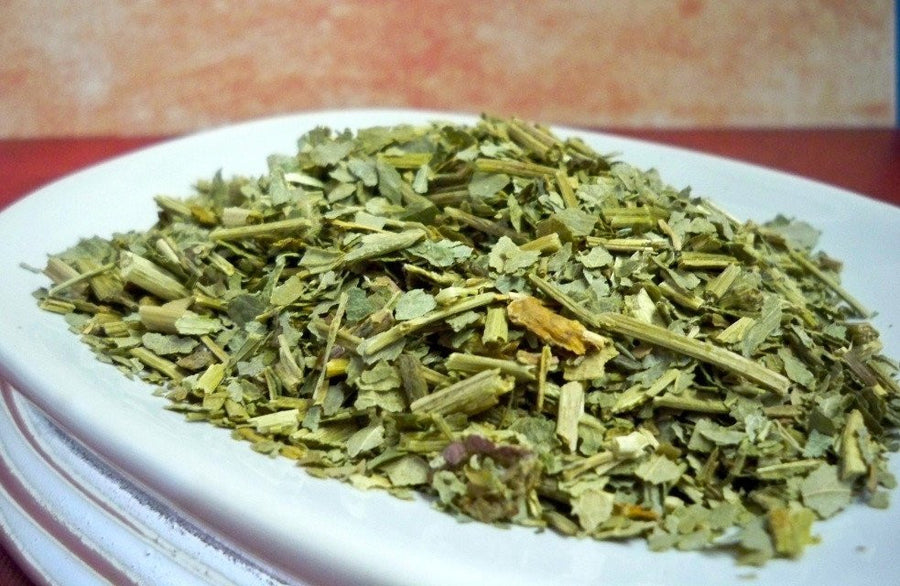
Description
Strawberry Leaf, Cut & Sifted
(Fragaria vesca / Fragaria × ananassa)
Fragaria vesca — Wild Strawberry, Woodland Strawberry, or Alpine Strawberry — is a delicate, low-growing perennial herb of the family Rosaceae native to the temperate forests and meadows of Europe, Asia, and North America, one of the most beloved and widely distributed wild plants in the Northern Hemisphere. The cultivated garden strawberry (Fragaria × ananassa) — the large-fruited strawberry familiar from markets and gardens worldwide — is a hybrid developed in 18th-century France from two American species (Fragaria virginiana from eastern North America and Fragaria chiloensis from Chile), but it is the leaves of both wild and cultivated strawberry that are used as a botanical herb. The genus name Fragaria derives from the Latin fragrans (fragrant) — a reference to the intensely sweet, perfumed aroma of the ripe fruit. Strawberry leaves have been used in European botanical and culinary traditions for centuries — they were a staple of medieval European herbal medicine, appearing in the works of the great herbalists John Gerard (1597) and Nicholas Culpeper (1653), and they have been used as a tea herb across Europe, particularly in Germany, France, and Scandinavia, where strawberry leaf tea is a traditional springtime beverage. The three-leaflet leaves of the strawberry plant are immediately recognizable — serrated, bright green on top and silvery-pale beneath — and they retain a faint, pleasant, slightly fruity aroma when dried.
Strawberry leaf contains a well-characterized phytochemical profile including tannins (ellagitannins and gallotannins — the primary compounds, responsible for the leaf’s characteristic astringency; including agrimoniin, pedunculagin, casuarictin, and potentillin), ellagic acid (a polyphenol formed from ellagitannins — one of the most studied plant phenolics), flavonoids (including quercetin, kaempferol, rutin, hyperoside, isoquercitrin, astragalin, and avicularin), phenolic acids (caffeic acid, ferulic acid, p-coumaric acid, chlorogenic acid), proanthocyanidins (condensed tannins), vitamin C (ascorbic acid — significant), vitamin K, folate, calcium, potassium, magnesium, iron, manganese, and phosphorus. Available in Cut & Sifted form.
Product Highlights
- Cut & sifted leaf of Fragaria vesca / Fragaria × ananassa — Strawberry Leaf
- The genus name Fragaria derives from the Latin fragrans (fragrant) — a reference to the intensely sweet aroma of the ripe fruit
- Used in European botanical and culinary traditions for centuries — featured in the herbals of John Gerard (1597) and Nicholas Culpeper (1653)
- A traditional springtime tea herb across Germany, France, and Scandinavia
- Rich in ellagitannins — agrimoniin, pedunculagin, casuarictin — and ellagic acid, one of the most studied plant polyphenols
- Excellent source of vitamin C, vitamin K, and flavonoids — quercetin, kaempferol, rutin, and hyperoside
- Mild, pleasant, slightly fruity and astringent flavor — one of the most enjoyable of all leaf teas
- Available in Cut & Sifted form
How to Use
Herbal Tea (Infusion): Steep 1–2 teaspoons of cut & sifted strawberry leaf in 8 oz of hot water for 10 minutes; strain. The flavor is mild, slightly astringent, pleasantly grassy with a faint fruity note — delicious on its own or blended. Excellent hot or iced. Fruit Blends: A natural pairing with raspberry leaf, rose hip, hibiscus, and lemon balm in fruit-forward herbal tea blends. Iced Tea: Brew double-strength and pour over ice for a refreshing summer iced tea. Culinary: Young, tender strawberry leaves can be used fresh in salads in the European tradition. Herbal Blends: Combines beautifully with red clover, oat straw, and nettle leaf in traditional nourishing herbal infusions.
Available in Cut & Sifted (2 oz, 4 oz, 8 oz, 16 oz).
Keep out of reach of children. Store in a cool, dry place away from direct sunlight.