
Description
Shatavari Root Powder — Certified Organic
(Asparagus racemosus)
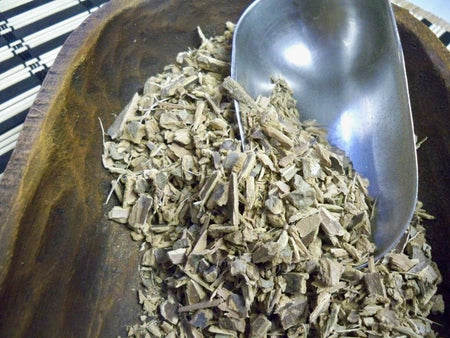
Asparagus racemosus — Shatavari — is one of the most revered and widely used botanicals in Ayurvedic medicine, a climbing, thorny perennial vine of the family Asparagaceae native to the tropical and subtropical forests of India, Sri Lanka, Nepal, and the Himalayas, where it grows in rocky, gravelly soils at elevations up to 1,400 meters. Asparagus racemosus is closely related to the common culinary asparagus (Asparagus officinalis) — both belong to the same genus — but it is the tuberous roots of Asparagus racemosus, not the shoots, that are the primary botanical product. The Sanskrit name Shatavari (शतावरी) translates as “she who possesses a hundred husbands” or “having a hundred roots” — a reference both to the plant’s extensive, clustered root system (a single plant can produce 100 or more tuberous roots) and to its extraordinary importance in Ayurvedic botanical tradition, where it has been used for thousands of years as one of the primary rasayana (rejuvenating tonic) herbs and one of the most important botanicals in the Ayurvedic materia medica. Shatavari is described in the ancient Ayurvedic texts Charaka Samhita and Sushruta Samhita — among the oldest medical texts in the world — as a cooling, nourishing, and deeply tonic botanical. Our Certified Organic Shatavari Root Powder is produced from the tuberous roots of Asparagus racemosus, dried and ground to a fine powder.
Asparagus racemosus root contains a well-characterized array of phytochemicals including steroidal saponins — the primary bioactive compounds — most notably the shatavarin series: shatavarin I, shatavarin II, shatavarin III, shatavarin IV (the primary saponin and quality marker), shatavarin V, and related steroidal glycosides; along with racemosol (a spirostanolic saponin), asparagamine A (a polycyclic alkaloid), racemofuran, racemosides A and B (furostanolic saponins), isoflavones (including 8-methoxy-5,6,4′-trihydroxyisoflavone-7-O-β-D-glucopyranoside), quercetin, rutin, kaempferol, diosgenin (a steroidal sapogenin), sitosterol, stigmasterol, polysaccharides (including mucilaginous fructooligosaccharides), asparagine, arginine, tyrosine, flavonoids, tannins, resin, starch, vitamin C, vitamin A (beta-carotene), zinc, manganese, copper, and calcium. Certified Organic. Available in Powder form.
Product Highlights
- Certified Organic root powder of Asparagus racemosus — Shatavari (शतावरी)
- One of the most revered botanicals in Ayurvedic medicine — described in the Charaka Samhita and Sushruta Samhita, among the oldest medical texts in the world
- The name Shatavari — “she who possesses a hundred roots” — reflects the plant’s extraordinary clustered tuberous root system
- Closely related to culinary asparagus (Asparagus officinalis) — same genus, different species and botanical use
- Native to the tropical and subtropical forests of India, Sri Lanka, Nepal, and the Himalayas
- Primary bioactive compounds: the shatavarin saponin series (I–V) — steroidal glycosides unique to Asparagus racemosus
- Classified in Ayurveda as a primary rasayana (tonic) herb — one of the most important botanicals in the classical Ayurvedic materia medica
- Certified Organic — available in Powder form
How to Use
Traditional Ayurvedic Preparation (Milk Decoction): Simmer ½–1 teaspoon of shatavari powder in 8 oz of warm milk (dairy or plant-based) with honey and a pinch of cardamom or ashwagandha — the traditional Ayurvedic preparation known as kshirapaka. The flavor is mild, slightly sweet, and starchy. Smoothies: Blend ½–1 teaspoon into smoothies with banana, dates, and warm spices. Herbal Formulas: Combine with ashwagandha, brahmi, or other Ayurvedic botanicals in traditional tonic formulas. Encapsulation: Fill capsules for convenient daily use. Golden Milk: Add to golden milk preparations alongside turmeric, ginger, and black pepper.
Certified Organic. Available in Powder (4 oz, 8 oz, 16 oz).
These statements have not been evaluated by the Food and Drug Administration. This product is not intended to diagnose, treat, cure, or prevent any disease. Consult your healthcare provider before use if you are pregnant, nursing, taking medications, or have a medical condition. Do not use if you have an allergy to asparagus or other plants in the Asparagaceae family. Keep out of reach of children.
Related products