Description
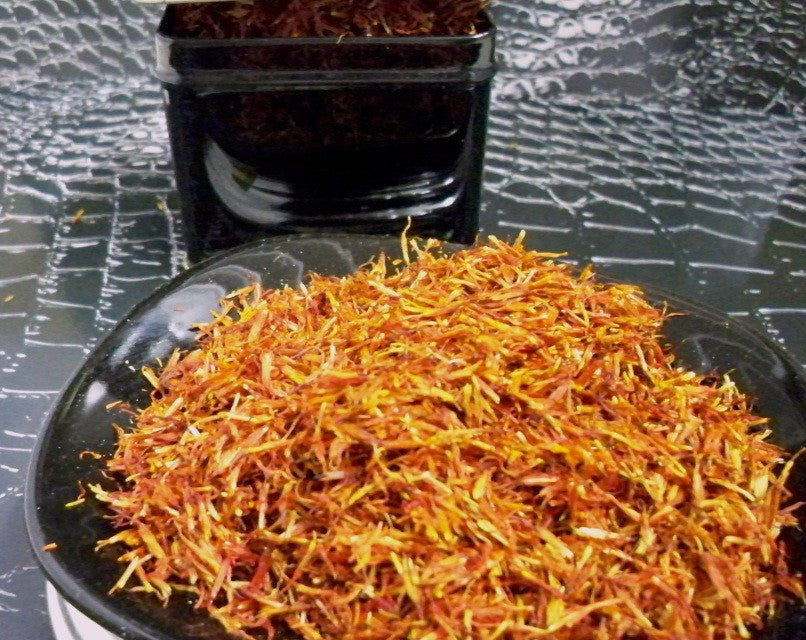
Safflower Petals, Premium Grade
(Carthamus tinctorius)
Carthamus tinctorius — Safflower, False Saffron, or Dyer’s Saffron — is one of the oldest cultivated plants in human history, with archaeological evidence of cultivation dating back over 4,000 years to ancient Egypt, where safflower petals were found in the tomb of Tutankhamun and used to dye the linen wrappings of mummies. A thistle-like annual of the family Asteraceae native to the Middle East and Central Asia, safflower has been cultivated across the ancient world — from Egypt and the Mediterranean to Persia, India, and China — primarily for three purposes: its brilliant orange-red petals, used as a textile dye and food colorant; its seeds, pressed for one of the world’s most important edible and industrial oils; and its flowers, used as a saffron substitute in cooking and as a botanical preparation in traditional medicine. The name “False Saffron” and “Dyer’s Saffron” reflect safflower’s long history as an affordable substitute for the far more expensive true saffron (Crocus sativus) — safflower petals impart a similar golden-orange color to foods and textiles, though with a milder, more neutral flavor. Our Premium Grade Safflower Petals are selected for their superior color intensity, vibrant orange-red hue, and high concentration of pigment compounds — the hallmarks of premium quality safflower.
Safflower petals are rich in carthamin (a red chalcone pigment — the primary red colorant, water-insoluble), safflower yellow (hydroxysafflor yellow A and B — the primary yellow pigments, water-soluble), carthamone, luteolin and luteolin glycosides (flavonoids), quercetin, kaempferol, serotonin derivatives (including N-feruloylserotonin and N-(p-coumaroyl)serotonin — characteristic of safflower), polysaccharides, essential oils (in small amounts), and organic acids. Available in Whole Petal form.
Product Highlights
- Whole petals of Carthamus tinctorius — Safflower / False Saffron / Dyer’s Saffron — Premium Grade
- One of the oldest cultivated plants in human history — safflower petals found in the tomb of Tutankhamun (circa 1323 BC)
- Selected for superior color intensity and high concentration of carthamin and safflower yellow pigments
- A historic textile dye, food colorant, and saffron substitute across ancient Egyptian, Persian, Indian, and Chinese cultures
- Rich in carthamin (red pigment), safflower yellow (yellow pigment), luteolin, quercetin, and serotonin derivatives
- Versatile across culinary, aromatic, cosmetic, and craft applications
- Available in Whole Petal form
How to Use
Culinary Colorant & Saffron Substitute: Steep a pinch of safflower petals in warm water or broth to extract the golden-orange color; use to color rice, soups, stews, and paella as an affordable saffron alternative. The flavor is mild and neutral — the color is the primary contribution. Herbal Tea: Add to herbal tea blends for vivid color and a mild, slightly bitter floral note — pairs beautifully with hibiscus, rose petals, and chamomile. Natural Dye: Use to dye natural fibers (wool, silk, cotton) in shades of yellow to orange-red — a traditional textile dye application. Potpourri & Floral Arrangements: The vivid orange-red petals add striking color to potpourri, dried floral arrangements, and decorative botanical displays. Cosmetics & Soap: Incorporate into cold-process soaps, bath salts, and botanical cosmetics for natural color.
Available in Whole Petal (2 oz, 4 oz, 8 oz). Premium Grade.
Keep out of reach of children.
Related products