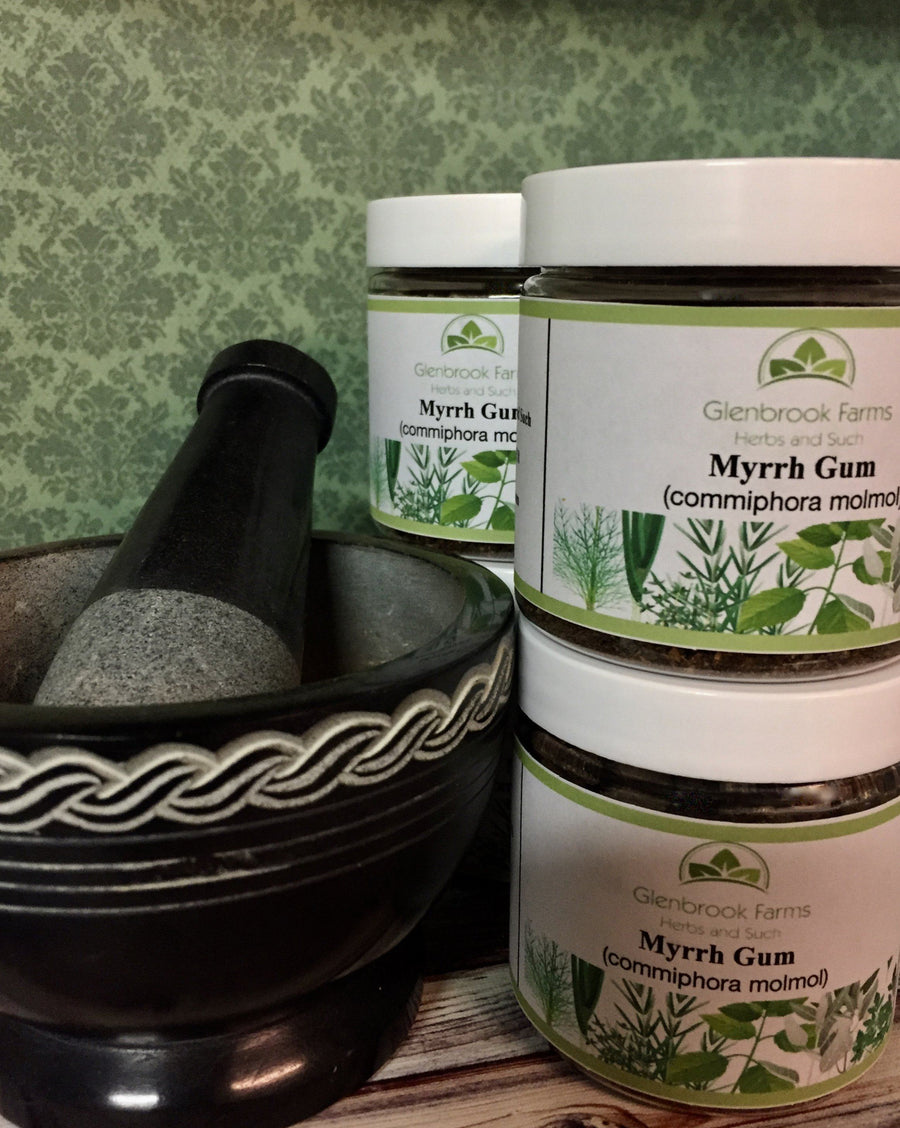
Description
Myrrh Gum
(Commiphora myrrha / Commiphora molmol)
From the Horn of Africa and the Arabian Peninsula
Myrrh is one of the most historically significant and culturally resonant substances in all of human civilization — a fragrant, bitter oleoresin harvested from small, thorny trees of the genus Commiphora (family Burseraceae) native to the arid, rocky landscapes of the Horn of Africa (Somalia, Ethiopia, Eritrea) and the Arabian Peninsula (Yemen, Oman). For over 4,000 years, myrrh has been one of the most prized and valuable commodities in the ancient world — traded along the great incense routes of Arabia, carried by camel caravan across the deserts of the Middle East, and exchanged at the markets of ancient Egypt, Greece, Rome, Persia, and India.
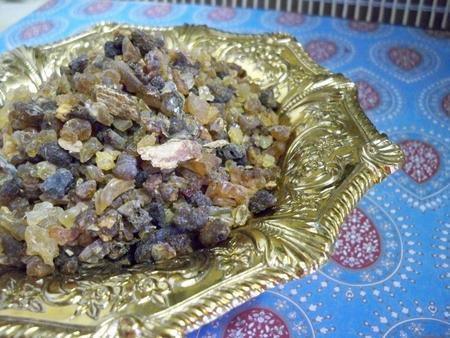
Myrrh is produced when the bark of Commiphora trees is wounded — either naturally or by deliberate incision — causing the tree to exude a pale yellow resin that hardens on contact with air into the characteristic reddish-brown, irregular lumps of gum resin known as “tears.” The word “myrrh” derives from the ancient Semitic root mur or mor, meaning “bitter” — a reference to its intensely bitter taste. The same root gives us the Hebrew mor (מֹר), the Arabic murr (مُرّ), and is etymologically connected to the name Miriam (Mary).
In ancient Egypt, myrrh was one of the most important substances in the entire civilization — used in the embalming and mummification of pharaohs and nobles, burned as incense in temple rituals, used in the preparation of kyphi (the sacred incense of ancient Egypt, a complex blend of 16 ingredients including myrrh, frankincense, cinnamon, and wine), and incorporated into cosmetics and perfumes. The Ebers Papyrus (c. 1550 BCE) — one of the oldest medical documents in existence — lists myrrh in numerous preparations. Queen Hatshepsut (c. 1507–1458 BCE) famously sent an expedition to the Land of Punt (believed to be modern Somalia or Eritrea) to bring back living myrrh trees to plant in the gardens of her mortuary temple at Deir el-Bahari.
In the Hebrew Bible, myrrh appears over 150 times — as one of the ingredients of the holy anointing oil prescribed by God to Moses (Exodus 30:23), as a perfume used by Queen Esther, and as a fragrance in the Song of Solomon. In the New Testament, myrrh is one of the three gifts brought by the Magi to the infant Jesus (Matthew 2:11), offered to Jesus on the cross mixed with wine (Mark 15:23), and used with aloes to prepare his body for burial (John 19:39). In ancient Greek and Roman medicine, myrrh was described by Dioscorides in his De Materia Medica (c. 50–70 CE) and by Pliny the Elder in his Naturalis Historia (77 CE).
Myrrh gum resin contains a complex array of phytochemicals including terpenoids (furanoeudesma-1,3-diene, lindestrene, curzerene, and other sesquiterpenes responsible for myrrh’s characteristic bitter, balsamic aroma), commiphoric acids (alpha, beta, and gamma — triterpene acids), commiphorinic acid, heerabomyrrhols, resins (alpha, beta, and gamma commiphora resins — approximately 25–40% of the gum), gum polysaccharides (approximately 60% of the gum), volatile oils (approximately 2–8% — including eugenol, cuminaldehyde, and m-cresol), and sterols (cholesterol, campesterol, beta-sitosterol). Available in Cut & Sifted resin pieces and Powder forms.
Product Highlights
- Cut & sifted resin tears and powder of Commiphora myrrha — Myrrh / Gum Myrrh / Mirra
- One of the most historically significant substances in human civilization — traded for 4,000+ years
- One of the three gifts of the Magi — mentioned over 150 times in the Hebrew Bible
- Used in ancient Egyptian mummification, kyphi incense, and the holy anointing oil of Moses
- Queen Hatshepsut sent expeditions to Punt (c. 1458 BCE) specifically to obtain living myrrh trees
- Rich in sesquiterpene terpenoids, commiphoric acids, volatile oils, and gum polysaccharides
- Available in Cut & Sifted and Powder forms
How to Use
Incense: Myrrh is most traditionally used as a loose incense — place resin pieces or powder on a lit charcoal disc and allow to smolder. The smoke is rich, warm, balsamic, and deeply aromatic — one of the most ancient and evocative fragrances in the world. Tincture: Myrrh resin dissolves readily in alcohol — prepare a tincture by soaking resin pieces or powder in high-proof alcohol for 2–4 weeks, shaking daily, then straining. Potpourri & Sachets: Add resin pieces to potpourri blends and sachets for a long-lasting, warm, balsamic fragrance. Perfumery: Myrrh is a classic base note in natural perfumery — infuse in jojoba oil or alcohol for use in perfume blends. Herbal Formulas: Used in compound herbal preparations by experienced practitioners. Powder: Encapsulate or blend into herbal formula powders.
Available in Cut & Sifted (4 oz, 8 oz, 16 oz) and Powder (1 oz, 4 oz, 8 oz, 16 oz).
These statements have not been evaluated by the Food and Drug Administration. This product is not intended to diagnose, treat, cure, or prevent any disease. Consult your healthcare provider before internal use, especially if you are pregnant (myrrh may stimulate uterine contractions), nursing, taking medications, or have a medical condition. Keep out of reach of children.
Related products