Description
Mustard Seed
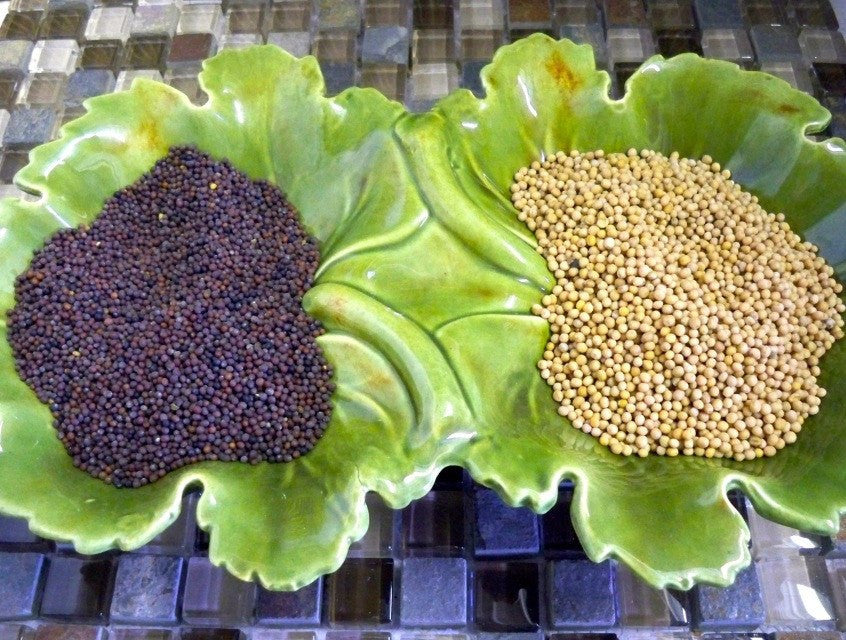
Yellow (Sinapis alba) · Brown (Brassica juncea)
Mustard is one of the oldest cultivated spice plants in human history — seeds of Sinapis and Brassica species have been found in prehistoric archaeological sites across Europe and Asia, and mustard is mentioned in ancient Sanskrit texts dating to 3000 BCE, in the Bible (Matthew 13:31 — the parable of the mustard seed), in the Talmud, and in the writings of the Greek physician Hippocrates (c. 460–370 BCE). The Roman naturalist Pliny the Elder devoted an entire section of his Naturalis Historia (77 CE) to mustard, listing 40 medicinal uses and describing how the Romans mixed ground mustard seed with unfermented grape juice (mustum) to make a paste — giving us the word “mustard” itself, from the Latin mustum ardens — “burning must.”
By the medieval period, mustard had become one of the most important condiments in European cuisine — so important that the city of Dijon, France established a guild of mustard makers in 1634, and the phrase “keen as mustard” entered the English language as a synonym for enthusiasm and sharpness. Today mustard is the second most traded spice in the world by volume (after pepper), and mustard seed is a foundational ingredient in cuisines from India and Bangladesh to France, Germany, and the American South.
Yellow Mustard Seed (Sinapis alba)
Yellow mustard — also called white mustard — is the milder of the two varieties, with a bright, tangy, slightly sharp flavor that is warm rather than fiery. Sinapis alba is native to the Mediterranean basin and has been cultivated in Europe for millennia. The seeds are pale yellow to tan in color, larger than brown mustard seeds, and contain sinalbin (a glucosinolate that produces p-hydroxybenzyl isothiocyanate upon enzymatic hydrolysis — a mild, water-soluble compound responsible for yellow mustard’s characteristic gentle heat). Yellow mustard seeds are the primary ingredient in American-style yellow mustard, ballpark mustard, and most commercial prepared mustards. The seeds are also rich in fixed oils (approximately 28–36% by weight, primarily erucic acid, oleic acid, and linoleic acid), protein (approximately 28%), mucilage, sinapine (a choline ester of sinapic acid), flavonoids (kaempferol, quercetin), and minerals (selenium, magnesium, calcium, phosphorus).
Brown Mustard Seed (Brassica juncea)
Brown mustard — also called Indian mustard or Chinese mustard — is significantly more pungent and complex than yellow mustard, with a sharp, fiery, deeply aromatic heat that develops rapidly when the seeds are crushed or ground and mixed with liquid. Brassica juncea is native to the foothills of the Himalayas and has been cultivated in South Asia for over 5,000 years — it is the dominant mustard of Indian, Bangladeshi, and South Asian cuisine, where mustard oil pressed from the seeds is a primary cooking fat in Bengal, Odisha, and Punjab. Brown mustard seeds contain sinigrin (a glucosinolate that produces allyl isothiocyanate upon enzymatic hydrolysis — the same volatile compound responsible for the heat of horseradish and wasabi, and far more pungent than the compound in yellow mustard). Brown mustard is the primary seed in Dijon mustard, whole grain mustard, spicy brown mustard, and most European artisan mustards.
The Science of Mustard Heat
Mustard seeds contain no heat in their dry, intact state — the pungency develops only when the seeds are crushed or ground and mixed with liquid, which triggers an enzymatic reaction: the enzyme myrosinase (released when cell walls are broken) reacts with glucosinolates (sinalbin in yellow, sinigrin in brown) to produce isothiocyanates — the volatile compounds responsible for mustard’s characteristic heat. Hot water or vinegar stops this reaction, locking in a milder heat; cold water allows it to continue, producing maximum pungency. This is why Dijon mustard (made with verjuice or white wine) is sharper than American yellow mustard (made with vinegar and turmeric).
Product Highlights
- Yellow Mustard Seed (Sinapis alba) — mild, tangy, bright; available Ground and Whole
- Brown Mustard Seed (Brassica juncea) — pungent, fiery, complex; available Whole
- One of the oldest cultivated spices — documented in Sanskrit texts from 3000 BCE
- “Mustard” from Latin mustum ardens — “burning must” — named by the Romans
- The second most traded spice in the world by volume (after pepper)
- Rich in glucosinolates, fixed oils, sinapine, flavonoids, selenium, and protein
How to Use
Whole Seeds — Tempering (Indian technique): Heat oil in a pan until shimmering, add whole mustard seeds, and cover — they will pop and crackle within seconds, releasing a nutty, aromatic flavor completely different from raw seeds. Essential in Indian dal, curry, and vegetable dishes. Pickling: Whole yellow and brown mustard seeds are a foundational ingredient in pickling spice blends — they add flavor and act as a natural preservative. Whole Grain Mustard: Combine whole seeds with vinegar, salt, and spices and blend partially for a rustic, textured whole grain mustard. Ground Yellow — Prepared Mustard: Mix ground yellow mustard with cold water, vinegar, turmeric, and salt for classic American-style mustard. Rubs & Marinades: Add ground yellow mustard to dry rubs for pork, chicken, and beef — it acts as a binder and adds depth. Sauces & Dressings: Whisk ground mustard into vinaigrettes, cream sauces, and hollandaise. Bread & Baking: Add whole seeds to bread dough, pretzels, and crackers for texture and flavor.
Available in Ground Yellow (8 oz, 16 oz) and Whole Yellow and Whole Brown (16 oz).
Related products