
Description
Essiac Type Tea
A traditional four-herb botanical blend inspired by one of the most well-known herbal formulas of the 20th century — a combination of burdock root, sheep sorrel, slippery elm bark, and rhubarb root that has been prepared and consumed as an herbal tea for over a century. This blend makes approximately 4 gallons of prepared tea. Brewing instructions are included.
Ingredients: Burdock Root (Arctium lappa), Sheep Sorrel (Rumex acetosella), Slippery Elm Bark (Ulmus rubra), Rhubarb Root (Rheum officinale / Rheum palmatum).
The History of This Blend
This four-herb formula has a fascinating and well-documented history in North American botanical tradition. The blend is most closely associated with Rene Caisse (1888–1978), a Canadian nurse from Bracebridge, Ontario, who began preparing and distributing this herbal tea formula in the 1920s after reportedly receiving it from a patient who attributed it to an Ojibwe healer. Caisse named the formula Essiac — her surname spelled backwards — and administered it to patients at her clinic in Bracebridge for decades. The formula gained widespread public attention in Canada and the United States throughout the mid-20th century and remains one of the most recognized herbal tea blends in North American botanical history. The four herbs in this blend — burdock root, sheep sorrel, slippery elm bark, and rhubarb root — each have their own long and independent histories in European, North American, and Traditional Chinese botanical traditions.
Key Botanicals
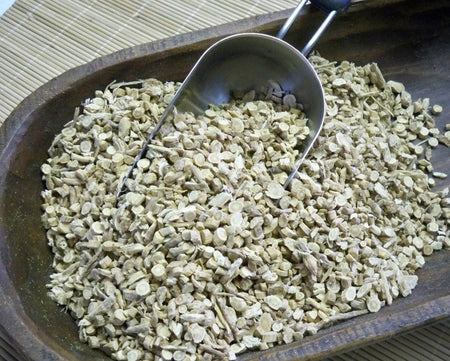
- Burdock Root (Arctium lappa) — a large-rooted biennial of the family Asteraceae native to Europe and Asia, widely naturalized in North America; contains arctiin (a lignan), inulin (up to 45% of dry weight), mucilage, tannins, caffeic acid, chlorogenic acid, quercetin, luteolin, and polyacetylenes; a classic root in European, North American, and Traditional Chinese botanical tradition; the root is also consumed as a food vegetable (gobo) in Japanese cuisine
- Sheep Sorrel (Rumex acetosella) — a small, slender perennial of the family Polygonaceae native to Europe and Asia, widely naturalized in North America; contains oxalic acid, calcium oxalate, anthraquinone glycosides, flavonoids (vitexin, orientin, hyperoside), tannins, vitamin C, and carotenoids; the leaves have a characteristic sharp, lemony, sour flavor owing to their high oxalic acid content
- Slippery Elm Bark (Ulmus rubra) — the inner bark of the slippery elm, a native North American tree of the family Ulmaceae; one of the most mucilaginous botanicals in North American herbal tradition, containing mucilaginous polysaccharides (primarily arabinogalactans and hexosans), tannins, phytosterols, calcium, magnesium, and vitamin E; listed in the United States Pharmacopoeia (USP) from 1820 through 1960
- Rhubarb Root (Rheum officinale / Rheum palmatum) — the root of Chinese or medicinal rhubarb, native to western China and Tibet; contains anthraquinone glycosides (including emodin, rhein, aloe-emodin, chrysophanol, and physcion), stilbene glycosides (including rhaponticin and desoxyrhaponticin), tannins (including gallic acid and ellagic acid), catechins, quercetin, kaempferol, calcium oxalate, and starch; used in Traditional Chinese Medicine (da huang) for over 2,000 years and listed in the Chinese Pharmacopoeia
How to Prepare
Full brewing instructions are included with each order. The traditional preparation involves a long, slow decoction of the dried herbs followed by straining and refrigeration. This blend makes approximately 4 gallons of prepared tea. Store prepared tea refrigerated and use within 2–3 weeks.
⚠️ Important: Sheep sorrel and rhubarb root contain oxalic acid and anthraquinone glycosides — individuals with kidney disease, a history of kidney stones, or those taking prescription medications should consult a qualified healthcare provider before use. Not recommended during pregnancy or nursing.
These statements have not been evaluated by the Food and Drug Administration. This product is not intended to diagnose, treat, cure, or prevent any disease.
Related products